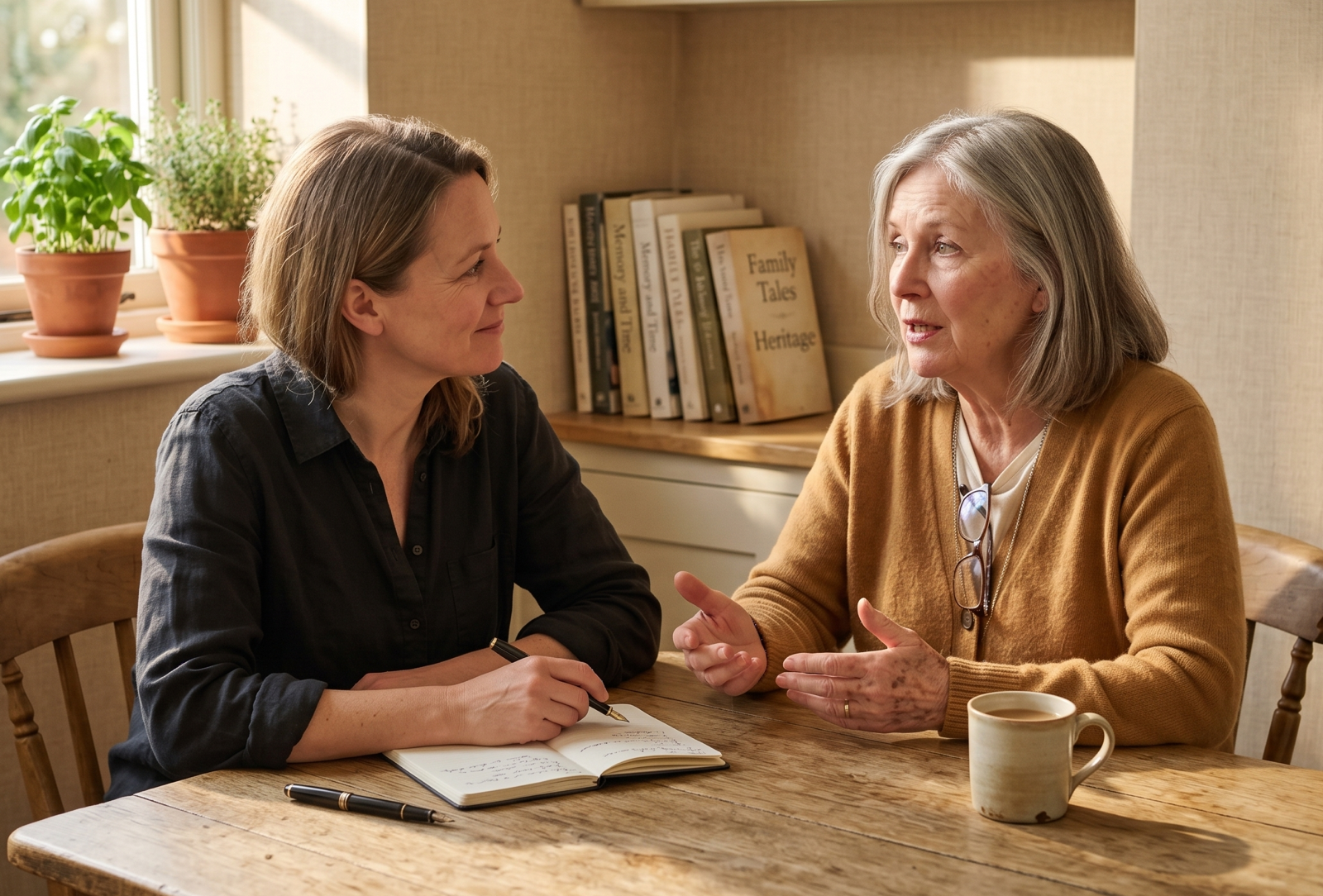
There is a particular kind of grief that doesn't announce itself at a funeral. It arrives quietly, weeks or months later, when you find yourself desperate to remember the exact way your father described his first job, or what your mother's hands looked like when she baked. The story was there. You just didn't write it down.
In brief
- Most people who lose a parent say the same thing: I wish I'd asked more questions.
- The barrier is rarely love or motivation – it's the absence of structure for the conversation.
- Short, regular sessions surface far more than one long marathon recording.
- The texture of a life – voice, pauses, particular phrases – cannot be reconstructed later.
- Chronicle handles the structure, so the conversation can just be a conversation.
Most people who have lost a parent say the same thing: I wish I'd asked more questions.
Most people who still have a parent say something different: I keep meaning to.
The gap between those two sentences is where Chronicle was born.
Why it doesn't happen
The intention is almost always there. What stops people isn't a lack of love – it's the conversation itself.
Sitting down with a parent and saying "I want to record your life story" feels surprisingly formal, even clinical. Parents often deflect. "What's interesting about me?" is the most common response.
The phone comes out, the recording starts, and then thirty seconds of silence while everyone waits for a natural beginning that never quite arrives.
The problem isn't motivation. It's structure. Without a shape to the conversation, most attempts collapse into the familiar: the well-worn anecdotes, the stories told at every Christmas dinner. The half of the life that's never been spoken about stays unspoken.
What actually works
The single most important thing you can do is remove yourself from the role of interviewer.
When you ask the questions, the conversation becomes about your relationship – what you know, what you've always wondered, what feels too personal to ask. When someone else asks the questions – even a prompt on a screen – the conversation changes register.
Your parent is no longer talking to their child. They're talking to an audience. And people tell different stories to audiences.
The second thing that works is short sessions over a long time. A two-hour recording marathon sounds efficient but rarely is. A thirty-minute conversation once a fortnight, over six months, is how you get the whole picture – the early years, the professional life, the doubts and changes and quiet pivots that never made it into family legend.
The third thing is knowing when to go deeper. The best life story recordings aren't a timeline – they're a texture. The smell of a kitchen. What it felt like to start a new job in a new city.
That texture comes from follow-up questions, not from ticking through decades.
What's lost – and what survives
Research into autobiographical memory consistently shows that the specific detail of a life – exact phrases, sensory impressions, the order of small events – fades much faster than the broad facts. Names and dates can be recovered from records. Texture cannot.
| Without a record | With a guided memoir |
|---|---|
| Fragments held by a few people | A complete arc, written in their voice |
| The well-worn family anecdotes | The half of the life that was never spoken |
| Names, dates and places – eventually hazy | The actual feel of how it was |
| The voice in your memory, gradually fading | Their phrasing, preserved verbatim |
| Photos without context on the back | Photos placed within the story they belong to |
The window is real
This is uncomfortable to say, and it is nevertheless true: the window closes.
Not dramatically, not usually. It closes gradually – a small decline in stamina here, a slight haziness about dates there. At some point the stories that could have been captured become the stories that were nearly captured.
This isn't a reason for panic. It is a reason to start.
If your parent is in their seventies or eighties, they almost certainly have stories you've never heard. Not because they're hiding them, but because no one has asked in the right way, at the right moment, with enough time to let the answer breathe.
The best time to start would have been five years ago. The second-best time is now.
How Chronicle helps
Chronicle is the structured stranger in the room. It asks the questions you would never quite know how to ask, in a register that lets a parent speak as themselves rather than as your parent. After each conversation it produces a written chapter – your parent's words, gently shaped – building over time into a complete memoir, printed and bound.
Frequently asked questions
How do I bring up the idea of recording a life story without it feeling awkward?
Often the best opening is honest and small: "I keep thinking I'd like to know more about your life – properly, not just the stories I've heard a hundred times." Most parents are quietly pleased. The awkwardness usually comes from trying to formalise it, and Chronicle removes the need for that – your parent is talking to the prompts, not to you.
What if my parent says they don't think their life is interesting enough?
This is the single most common response, and it is almost always wrong. The lives that feel unremarkable from the inside – the steady career, the ordinary town – are usually the ones that read most vividly, because they hold the texture of an era that has otherwise vanished.
How often should we have sessions, and how long should each one be?
Once a fortnight is a comfortable rhythm for most families. Sessions of thirty to forty-five minutes work best – long enough for an answer to breathe, short enough that nobody tires. Regularity over a few months matters more than intensity over a weekend.
What if my parent has begun to lose their memory?
Begin now, and begin with what they still hold clearly. Long-term autobiographical memory – childhood, early adulthood, the texture of a working life – often remains accessible long after recent memory has started to fade. A guided process draws out what is still there, gently and without pressure.
Can children and grandchildren contribute their own questions?
Yes. Many families add their own prompts over time, or sit alongside the parent during a session. Chronicle is built so the story remains the parent's, but the family can shape what gets asked.
Chronicle guides your parent through a series of gentle, structured conversations – at their pace, in their own words. The result is a beautifully written memoir chapter for each session, building over time into a complete life story. Find out how it works →