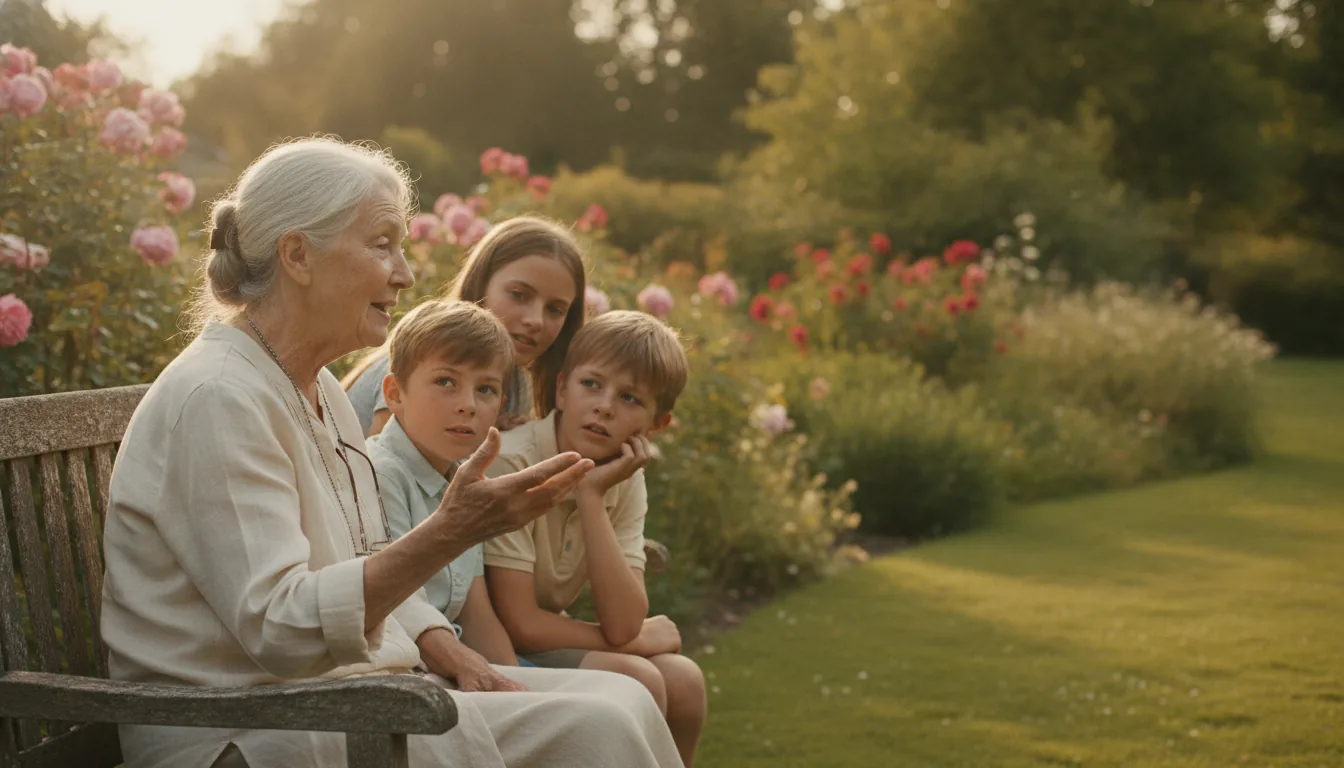
If you want to record your grandparents' stories, the summer holidays are the best window you'll get all year – and the reason has nothing to do with the weather. It's the time. Five or six unhurried weeks, the family in one place more often than usual, afternoons that don't have to end at a particular hour. The hard part of capturing a life story is rarely the questions. It's finding a moment that feels natural rather than staged. Summer hands you that moment. This is how to use it, without turning a relaxed visit into a project nobody enjoys.
In brief
- The UK summer holidays give you 5–6 weeks of the one thing capturing a life story actually needs: unhurried time.
- Don't plan a single big sit-down interview. Record in short, low-stakes sessions across several visits.
- A phone on the table is all the equipment you need – audio alone is often better than video.
- Bring the grandchildren in. The best stories come out when an older person is talking to a younger one.
- Start with one afternoon. You don't have to capture a whole life to make it worth doing.
Why summer is the right time to record grandparents' stories
Most attempts to record an older relative's stories fail for the same reason: they get scheduled like a meeting and they feel like one. You sit someone down, point a phone at them, and ask them to summarise eighty years on demand. It rarely works. People freeze, give short answers, and the recording ends up unwatched.
Summer dissolves that pressure. The conversations that produce real stories tend to happen sideways – after lunch in the garden, on a slow drive, while washing up together, when nobody is performing. The long holidays give you more of those in-between moments than any other time of year, and they give you something just as valuable: the freedom to not finish. If today only produces twenty good minutes, there's next week. That changes everything about how it feels.
There's a quiet urgency underneath the ease, too. The grandchildren are a year older and a year more curious. The grandparents are a year on. The window that feels permanent never quite is – and the regret of having let the summers pass is one of the most common things families describe when it's too late.
Plan for short sessions, not one big interview
The single most useful shift is to stop thinking about the recording and start thinking about recordings, plural. Aim for three or four short conversations of fifteen to thirty minutes across the holidays rather than one marathon.
Short sessions work better for almost everyone. Older voices tire. Memory warms up gradually – the good detail often arrives in the second conversation, once the first has loosened something. And a fifteen-minute chat is an easy yes, where "can I interview you about your whole life" is daunting to agree to and exhausting to deliver.
Give each session a loose theme so it has somewhere to go: childhood and home one afternoon, working life another, how they met your grandmother or grandfather another. You don't need a script. If you'd like a ready-made set of openers, our ten questions to ask your grandparents are built exactly for this – pick one or two per session and follow wherever the answer leads, rather than marching through a list.
Keep the equipment invisible
You already own everything you need. A phone laid flat on the table, set to record audio, is enough. Voice memos on an iPhone or the equivalent on Android will capture a clear conversation across a kitchen table without anyone thinking about it after the first minute.
Audio often beats video, and not only because it's less intrusive. A voice carries more than a face does in these moments – the accent, the pauses, the particular way someone says a name they haven't said aloud in years. Many families find the audio is the thing they treasure most. If you do want video, set the phone against a stack of books and leave it; the moment a camera is held, the conversation changes.
Two practical notes. Start the recording a little before the conversation properly begins – the unguarded opening lines are frequently the best, and you can always trim the start. And do a ten-second test first to check the levels, especially outside, where a breeze or distant traffic can swallow a soft voice.
Let the grandchildren do the asking
The best stories surface when an older person is talking to a much younger one. A grandchild asking "what did you do when you were my age?" gets an answer that no adult ever could, because the grandparent is no longer explaining their life to a peer – they're handing it down. The summer holidays put both generations in the same room with time to spare, which is precisely why this season is so well suited to it.
Give a curious eight- or fourteen-year-old two or three questions and let them run the conversation. They'll ask the blunt, brilliant follow-ups adults are too polite to ask, and the recording you end up with will be warmer than anything more formal. It also does something for the child: it turns a vague "Grandma who makes soup" into a real person with a real story, which is a gift in itself.
What to do with what you capture
The most important step is simply to not lose it. Voice memos buried on a phone are how good intentions quietly disappear. After each session, back the file up somewhere safe – a cloud drive, emailed to yourself, anywhere it isn't one cracked screen away from gone. Give each file a clear name and date.
From there, the choice is yours. Some families are happy keeping the raw audio. Others want the stories shaped into something that lasts – transcribed, ordered, and printed into a book a grandchild can take down off a shelf in forty years. That gap, between a folder of recordings and a finished keepsake, is the part most people never manage on their own, and it's exactly the part Chronicle is built to handle: it guides the conversations, turns them into a properly written life story, and produces a physical book at the end. But the technology matters far less than the decision to begin. The recordings only exist if someone presses record.
Start with one afternoon
You don't have to capture an entire life this summer. You have to capture one afternoon. The pressure to do it all is what stops most families doing any of it – so let that go. Pick a warm, slow day in the next few weeks, sit down with a cup of tea and a phone on the table, and ask one real question. Whatever comes back will be more than you had before, and it will very likely be the start of something you're grateful for long after the summer ends.
If you'd like a gentle way to turn those conversations into a keepsake that outlives the recordings, here's how Chronicle works.