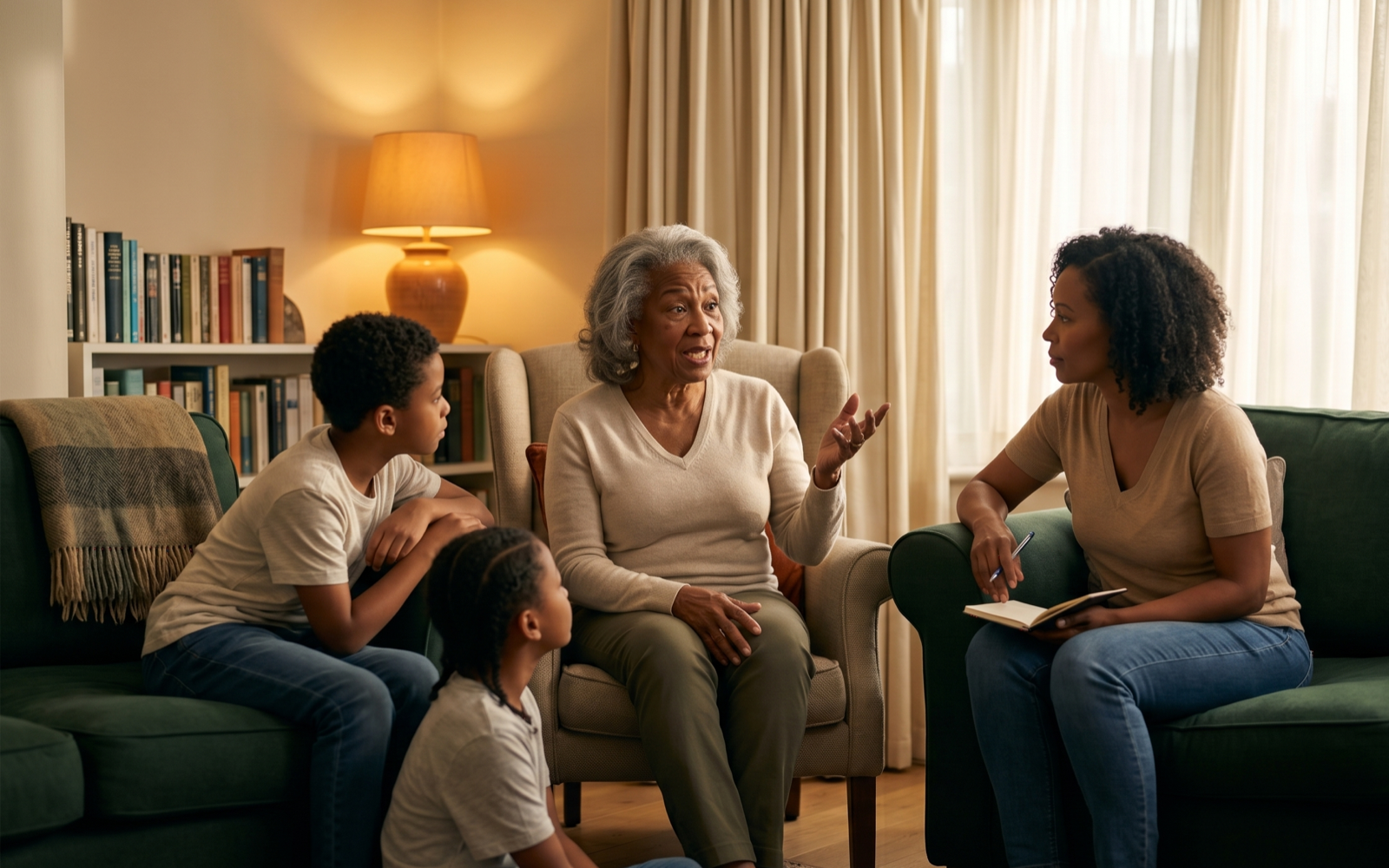
There is no archive for the way your grandmother described the house she grew up in. No database for the exact feeling your grandfather had when he got on a train to a city he'd never seen. No library that holds the conversation your aunt had with her mother the morning before the funeral.
In brief
- The generation now in their seventies and eighties remembers a Britain that no longer exists.
- Personal history rarely survives three generations without deliberate recording.
- A memoir is not a history book – it is a letter to the people who come after.
- Every family that does this says the same thing: we should have started sooner.
- Chronicle was built to make that beginning easy.
These things exist in one place only: the memory of the person who lived them.
And that person is getting older.
What we are losing
The generation now in their seventies and eighties grew up in a world that no longer exists – not just technologically, but culturally and socially. They remember rationing and its end.
They remember what British towns looked like before the ring roads. They remember the texture of industries that have since disappeared, the sound of streets that have since changed beyond recognition.
The Windrush generation, who came to Britain from the Caribbean between 1948 and 1973, carried with them a history of movement and settlement and resistance that their grandchildren are only now beginning to recover. The communities who left rural Wales and Scotland for the industrial cities of England carry a story of displacement and reinvention that rarely makes it into official history. The women who quietly built careers in decades that told them they couldn't carry knowledge of a different kind of endurance.
None of this is dramatic. Most of it happened quietly, in kitchens and on factory floors and in evening classes and in the small negotiations of daily life. That is precisely why it's worth saving.
How quickly different kinds of story disappear
Narrative-identity research, much of it associated with the psychologist Dan McAdams, has shown that the strongest and most detailed autobiographical memories form between the ages of roughly fifteen and thirty – a window sometimes called the reminiscence bump. These are the memories most vulnerable to loss, because they are the ones least often retold in family conversation.
| Type of story | Lives in | First to disappear |
|---|---|---|
| Major life events (births, marriages, moves) | Public records and family lore | Survives generations |
| Daily texture of an era | One generation only | Within a generation of the person's death |
| Voice, pauses, particular phrases | Recordings, if any exist | Immediately, if nothing was recorded |
| Private feelings, regrets, joys | The person alone | The moment they stop being asked |
| Cultural memory of a specific community | A diminishing group | Within two generations without active preservation |
Why it disappears
The loss of personal history is not sudden. It is incremental, and it accelerates.
In the first generation, the person who lived the story is still alive. The family has access to everything – they just need to ask.
In the second generation, the person is gone but siblings and cousins and friends still remember, still overlap, still carry fragments. By the third generation, the fragments are all that remain. By the fourth, even the fragments are gone.
The families who have their history are the families who captured it while they could.
What a family memoir actually is
A memoir is not a history book. It doesn't need to be exhaustive or objective or literary.
It simply needs to be honest and specific – a record of how a particular life felt from the inside.
The best family memoirs read like letters. They're addressed to someone: a grandchild who hasn't been born yet, a great-niece who will grow up wondering where she came from. They answer the questions that child will eventually have, in the voice of the person who lived the answer.
What were you like when you were young? What did you want, before life shaped what you got? What do you know now that you wish you'd known then?
These are not questions that get answered at dinner. They get answered in the context of something more deliberate – a conversation that creates the space for them.
The families who are already doing it
Every family that starts the process of capturing its history says the same thing at the end: we should have started years ago.
Not because what they captured is insufficient – usually it's far more than they expected. But because the conversations themselves were a gift. The person doing the telling felt, often for the first time in years, that their life was worth listening to. Questions were answered that no one had thought to ask.
The families who do this aren't doing it because they have a grand sense of their own historical importance. They're doing it because they understand that all history is personal history, and that the personal variety disappears first.
How Chronicle helps
Chronicle was built for these conversations. A guided sequence of thoughtful questions moves through a life over a series of sessions, and each session produces a written chapter in the person's own voice. The finished memoir is printed and bound as a book that lives on the shelves of every home in the family.
Frequently asked questions
Why is it so important to record family stories now?
Because the generation born in the 1940s and 1950s is the last one who remembers post-war Britain firsthand – and the texture of that period, the daily detail rather than the headlines, only exists in their memory. Once they're gone, the records remain but the lived experience does not.
How is a memoir different from genealogy?
Genealogy tells you who someone was related to. A memoir tells you what they thought, what they felt, and how they understood the world. Both are valuable; only one captures the person.
What if we already have photo albums and old recordings?
These are wonderful, and a memoir sits alongside them rather than replacing them. Photographs show what happened; a memoir explains why it mattered and what it was like.
Do I need to write my own memoir, or can someone else write it?
You can do it either way. Chronicle is designed so that you simply talk through the prompts; the writing is done for you, and you approve every chapter before it joins the book.
How long does it take to build a full family memoir?
Most families complete a memoir in three to six months of regular short sessions. A larger, multi-generation project can grow over years, with chapters added as more family members take part.
Chronicle was built for these conversations. A guided interview process that produces a written memoir chapter from each session, building over time into a complete life story – printed, bound, and given to the people it belongs to. See how it works →