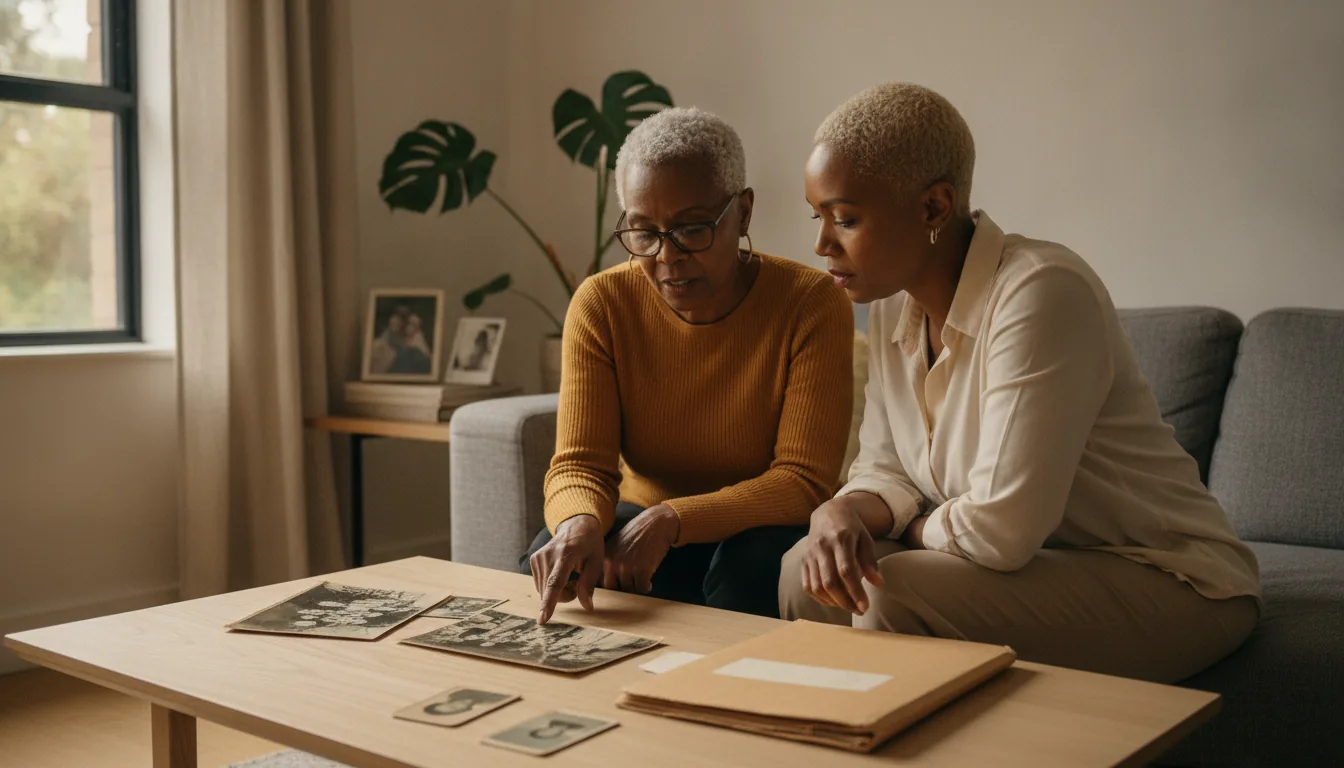
Anyone who has tried to trace a Black British family line tends to arrive at the same place: a point where the paper simply stops. Not because the family didn't exist, and not because nobody wrote anything down, but because the records that would have carried the story forward were incomplete, were never created, or in one well-documented case were destroyed by the government that held them. For a great many families, the most reliable archive of the last seventy years is not in a building. It is in the memory of people who are now in their seventies, eighties and nineties.
Black History Month begins on 1 October, and the 2026 theme is "Honouring Our Communities" – a deliberate turn towards the everyday people who built and sustained Black life in Britain rather than the handful whose names are already in books. Those are precisely the lives the formal record holds least well, which makes the weeks before October a good time to start rather than a good time to plan. This is a guide to finding what does survive, and to capturing what only survives in living memory.
In brief
- Thousands of Windrush-era landing cards were destroyed by the Home Office in 2010, removing documentation many families depended on
- Caribbean records vary enormously by island; many are incomplete, damaged, or were never created
- Passenger lists at The National Archives and the holdings of the Black Cultural Archives are the strongest surviving starting points
- For most families the richest source is a living relative, and that source has a deadline
- Where a parent or grandparent is reluctant to revisit the past, that reluctance usually has good reasons and is worth respecting
What happened to the paper
The gap in the record is not an accident of time, and it is worth being precise about why it exists.
In 2010 the Home Office destroyed thousands of landing card slips recording the arrival of people from the Caribbean. Children who had come to Britain on a parent's passport had been issued landing cards on arrival, and for many of them those slips were the only document evidencing their legal entry to the country. The consequences surfaced publicly years later, in what became known as the Windrush Scandal, when British citizens who had lived here for decades were asked to produce documentation that the state itself had disposed of. For family historians, the same event has a quieter effect: a specific, dated hole in the record precisely where a family's arrival should be.
Further back, the difficulties compound. Caribbean archives differ sharply from island to island in what was created, what was kept, and what can now be accessed. Records from before the 1830s are frequently incomplete or damaged, and in many rural districts registration was thin or non-existent because communities ran on oral tradition rather than paperwork. Hurricanes, fire and inconsistent storage have taken much of the rest.
None of this means research is futile. It means the balance between paper and memory is different here than it is for a family whose last four generations sat in the same English parish register.
Where to actually look
Several routes are genuinely productive, and it's worth exhausting the British sources before attempting overseas ones.
Passenger lists. The original inbound passenger lists covering the Windrush era are held at The National Archives, and they remain the single most useful documentary starting point for an arrival. They record names, ages, last address and intended address in the UK, which is often enough to bridge to a census or an electoral register.
The Black Cultural Archives. Based at 1 Windrush Square in Brixton, the Black Cultural Archives is the only heritage centre in Britain dedicated to collecting and preserving African and Caribbean history here. Its holdings include documents, photographs, objects and – importantly for this purpose – audio-visual material and oral history recordings.
Civil registration and the census. Once you have an address, standard British sources work normally: birth, marriage and death registration, census returns, electoral registers, and local newspaper archives for the towns where the family settled. Commercial genealogy services have also built dedicated Black British collections that group the relevant records together.
Employer and institutional records. The NHS, London Transport and British Rail recruited directly from the Caribbean, and surviving staff records, pension files and union documents sometimes place a person precisely when nothing else will.
Why living memory carries more weight here
Every family loses detail across generations. Migration accelerates it.
Research on language shift in migrant families describes a consistent three-generation pattern: the first generation speaks the heritage language, the second understands but answers in English, and by the third it survives as a handful of phrases. What travels with the language is context – who people in photographs were, why a family left when it did, what a place was like before it changed, which relatives stayed behind and what became of them.
Where the documentary record is strong, that loss is recoverable later. Where it is thin or has been destroyed, it isn't. A grandmother who arrived in 1961 is not merely a source of anecdote; for many periods and places she is the primary source, and there is no second copy.
There is also good evidence that what she knows matters directly to the youngest people in the family. Marshall Duke and Robyn Fivush at Emory University found that how much children knew of their family's history was among the strongest predictors of their self-esteem and resilience. The stories that carried the effect were not accounts of success but what the researchers termed oscillating narratives – hardship followed by recovery. A family that arrived with little and built something is that shape exactly.
When they don't want to talk about it
This is worth naming directly, because it is common and it is frequently misread as reticence or stubbornness.
Many people who arrived in Britain in the 1950s and 60s met open, organised hostility on arrival – in housing, in work, in the street. Some families were separated for years by the cost or the bureaucracy of travel. Some were caught up in the Windrush Scandal directly and spent years being told by their own government that they did not belong. A reluctance to reopen any of that is not evasion. It is a reasonable response to having lived through it.
A few things help. Start away from the difficult material rather than at it – early childhood before departure, food, music, school, the journey itself – and let them choose whether to move towards the harder years. Ask about other people rather than about themselves; many will talk at length about a sibling or a neighbour before they'll talk about their own experience. Accept a closed door when you meet one and return to it another day rather than pressing. And be honest about what you're doing and why, because the fear behind much of the reticence is that the story will be flattened into a grievance or a statistic rather than kept as a life.
Some of this lands more easily with someone outside the family. A parent who will not tell an adult child what the first winter was like will sometimes tell an interviewer, precisely because there is no relationship to protect.
Keeping it
Documentary research and recorded memory are not alternatives. The records give you dates, places and spellings; the conversation gives you everything the records were never designed to hold. The difference is that the archive will still be there next year.
Chronicle records life stories as guided conversations rather than written questionnaires, which matters here for a practical reason: many first-generation narrators are far more fluent speaking than writing, and a weekly written prompt is the format most likely to defeat them. The result is their account in their own voice, edited into a printed book the family keeps.
If you want the broader case for why first-generation stories are the ones most at risk, preserving family stories when your roots are in another country covers it. And if you're thinking about this as something to give rather than something to do yourself, the most meaningful Christmas gift for a parent from another country takes it from there.
The paper record for Black Britain is thinner than it should be, and in places it was thinned deliberately. The living record is not, yet.