

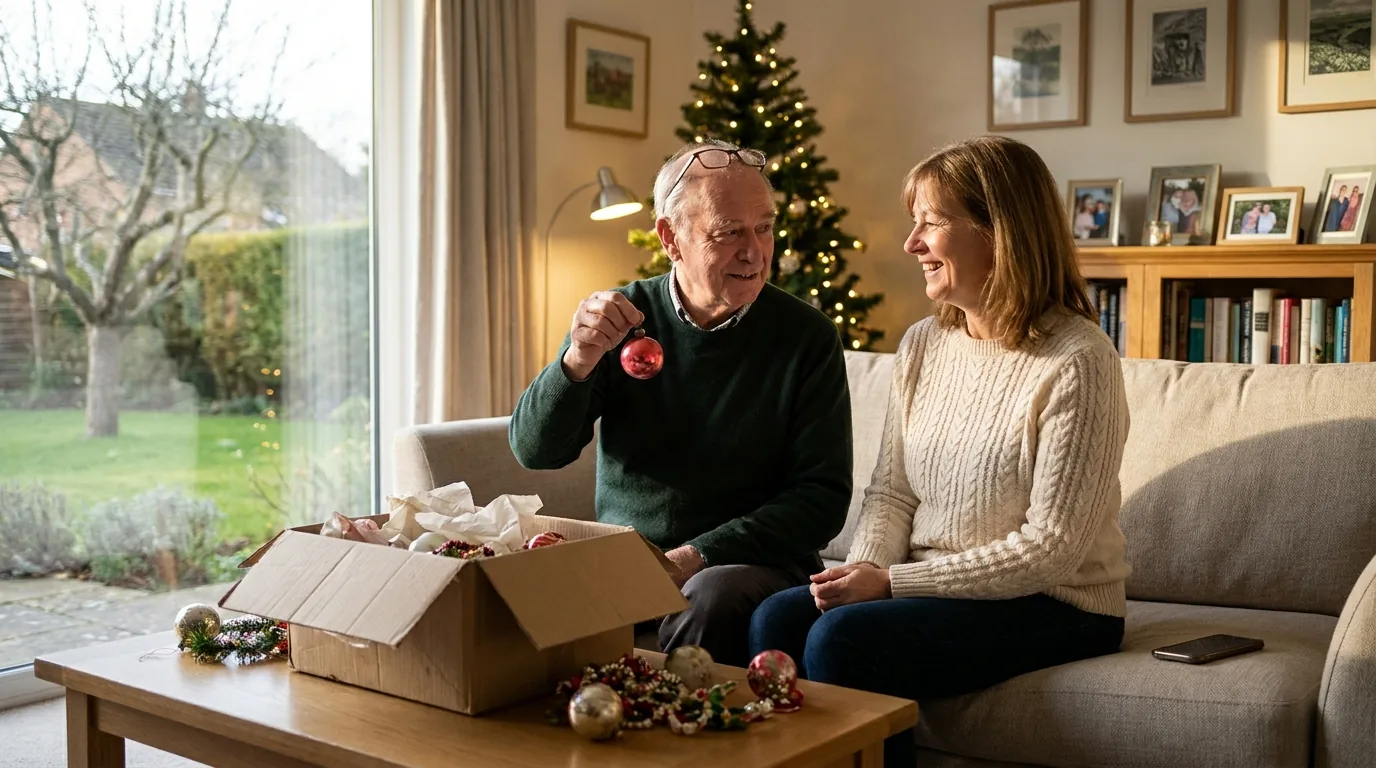
To record family stories at Christmas, ask your parent first, then use the voice recorder already on your phone: switch on Do Not Disturb, place the phone on a soft surface about an arm's length away and out of their eyeline, and let it run rather than stopping and starting. Audio is less intrusive than video and is usually all you need. The more important part comes afterwards. Within 24 hours, rename the file with who, what and when, back it up in two places, and write down the names, places and phrases you want to remember. Stories told over Christmas fade surprisingly quickly, even for the person who heard them. A recording you have labelled, backed up and noted is one the family will still have in ten years. One left as "New Recording 14" probably won't be.
In brief
- Ask before you record, say who will hear it, and accept a no
- Your phone's built-in recorder is enough; audio usually beats video
- Do Not Disturb on, phone on something soft, out of their eyeline, left running
- Within 24 hours: rename the file, back it up twice, write a few lines of notes
- Keep the original audio as well as any transcript – the voice is the part you can't replace
Before you press record: ask, and say what it's for
Recording someone is different from talking to them, and your parent should know which one is happening. Ask simply and early: "Would you mind if I recorded this? I'd love the family to have it." Say who is likely to hear it – you, your brother, the grandchildren one day – because "who's going to listen to this?" is often the real worry behind a hesitation.
Then accept the answer. A no on Christmas Eve can be a yes on Boxing Day, once the idea has settled. And if recording is never comfortable for them, you can still keep their stories: listen well, then write down what you remember the same evening.
Recording without telling them is not the answer. Apart from anything else, the stories are theirs, and they deserve a say in where they end up.
How to record family stories at Christmas on your phone
You don't need a microphone or a special app. Voice Memos on an iPhone and the recorder app on most Android phones are both perfectly good, and they're already in your pocket.
Set the phone up before the conversation starts
- Turn on Do Not Disturb or Aeroplane mode. A notification sound halfway through a story breaks the spell, and an incoming call can stop the recording altogether.
- Check the battery and storage. An hour of audio takes up very little space, but a phone on 6% won't see out a long story.
- Do a ten-second test. Record a sentence from where you'll be sitting and play it back. It takes a moment and saves a lot of disappointment.
Put it in the right place
Most poor recordings come down to placement. On a table, put the phone on a folded tea towel or napkin to soften the bumps and clinks, about an arm's length from your parent, and screen down. Keep it away from the television, the cooker extractor and the radiator fan – our ears filter those out, but a recording doesn't.
Out of their eyeline matters more than anything. A phone held up between you feels like a microphone, and people start to perform. A phone on the side of the table is usually forgotten within a few minutes.
Car journeys and Boxing Day walks are good for conversation but poor for recording. Road noise and wind drown out speech, and whoever is driving needs their attention on the road, not on a phone. Enjoy those conversations as they are, and write down what you heard when you get home.
Audio or video?
Audio is usually the better choice. It's less intrusive, people relax faster, and the voice is what you'll most want later. Video earns its place for things that need to be seen: how the stuffing is made, the way a card trick goes, the photographs being pointed at in an album.
Let it run
Don't stop and start the recording between stories. Some of the best moments come in the bits you'd never think to capture – the aside, the correction from across the room, the laugh before the punchline. Your job is to listen, not to produce. If you need some questions to open the conversation, our list of 20 questions to ask your parents this Christmas is a good place to start.
The first 24 hours: what to do before the stories fade
This is the part most people skip, and the reason so many family recordings are never listened to again.
Rename the file. "Dad – first Christmas in Hull – 26 Dec 2026" will mean something in 2040. "New Recording 14" won't.
Back it up in two places. Phones get lost, replaced and wiped. Save a copy to your computer or cloud storage, and send one to a sibling. Two copies in two places is the minimum.
Write five lines of notes. Names, places and dates as best you understood them. The phrase they used that made everyone laugh. Anything said after the phone was switched off – there is always something.
Note your follow-up questions. Every good story raises another. "Who was Auntie Peg?" is easy to ask in January and impossible to ask in 2040.
By January: turning recordings into something you'll keep
Many phones now produce a transcript automatically. It's a useful start, but read it through with the audio playing: names, places and dialect words are where automatic transcription goes wrong, and those are the details that matter most.
Share what you have with the rest of the family and ask them to add what they know. A brother may remember the other half of the story, or know that the house was in Grimsby, not Hull.
And keep the original audio, even once you have a neat transcript. A transcript tells you what was said. The recording tells you how – the accent, the pauses, the particular way a story built. We've written more about why your parents' voice is the thing to save.
Common questions
How long should a recording be?
As long as the conversation naturally runs, which is usually 15 to 40 minutes. Several short recordings across the holidays are better than one long session that tires everyone out. Stop while they still have more to say.
What if they freeze when the phone comes out?
Start talking before you start recording, then press record quietly once a story is under way. Ask about an object – a bauble, a photograph, an old Christmas card – rather than asking them to "tell you about" something. If they still freeze, put the phone away and enjoy the conversation. Our guide on how to interview your parent without it feeling like an interview has more ideas.
Is a phone recording good enough to keep?
Yes. A modern phone, well placed in a quiet room, records speech clearly enough to listen to for decades. Where you put the phone matters far more than which phone it is.
Keeping the conversation going after Christmas
A few good recordings from the holidays are a real achievement. The harder thing is carrying on once everyone has gone home and January has taken over.
That's what Chronicle was made for. It asks your parent one gentle question at a time, and they talk or type, at their own pace, over weeks rather than one afternoon. Then their answers are shaped into a life story in their own words, which they can read and change. You can see how it works here. With Memoir or Heirloom, the hardback includes a page the family can scan to hear them tell it.
If you're thinking of it as a Christmas present, there's no order-by date: the gift can arrive on Christmas morning, and they begin whenever they're ready.
But the recording you make this Christmas needs nothing more than your phone, a tea towel and a good question. Ask first, press record, and label it before you go to bed.